Sergeyich escorts Aisha to Ukraine
Grey BeesSergeyich escorts Aisha to Ukraine because her mother, Aisylu, wants her daughter to leave Crimea for an education and a safer future. The undertaking carries them through a border regime of passports, queues, soldiers, and a walk across the checkpoint on foot; at its end, Sergeyich helps Aisha find a train to Vinnytsia and entrusts her to Vitalina. The farewell is practical in its arrangements and unexpectedly intimate in its feeling: a journey made possible by a promise between people separated by war, and completed with an embrace neither traveler had planned.
Aisylu’s request and Aisha’s future
Aisylu first asks Sergeyich to help get Aisha away from Crimea. Her husband, Akhtem, is dead, and her son, Bekir, has been arrested. Sergeyich initially understands her appeal as a question about leaving for Donbas, but Aisylu clarifies that she wants Aisha to go to Ukraine for an education. She has herself returned from Uzbekistan while still a girl and has not left Crimea since, held back by fear; she therefore asks Sergeyich to advise her on where her daughter might go.
Sergeyich can offer only the knowledge of his own limited travels. He recalls that Horlivka and Donetsk were fine places once, then distinguishes that past from the present and recommends Vinnytsia as still a good destination. Aisylu turns the suggestion into a plan: the family will raise money and get Aisha to the Ukrainian side of the border. Sergeyich says he must return soon anyway and agrees to take her there. When Aisylu asks whether he will also help on the Ukrainian side, including putting Aisha on a bus to Vinnytsia, he first answers uncertainly, then confirms that he will.
The responsibility becomes concrete when Sergeyich explains the situation to Vitalina. Aisha is the daughter of a Tatar man he knew; her father is dead and her brother has been arrested, while her mother wants her to live in Ukraine and study. Sergeyich expects to get her as far as a bus to Vinnytsia, but recognizes that she may need someone to meet her and help her find the university. The request reconnects his undertaking with his estranged family: rather than treating the journey as a task that ends at the border, he asks his wife to extend its protection to Aisha at the far end.
Planning the crossing
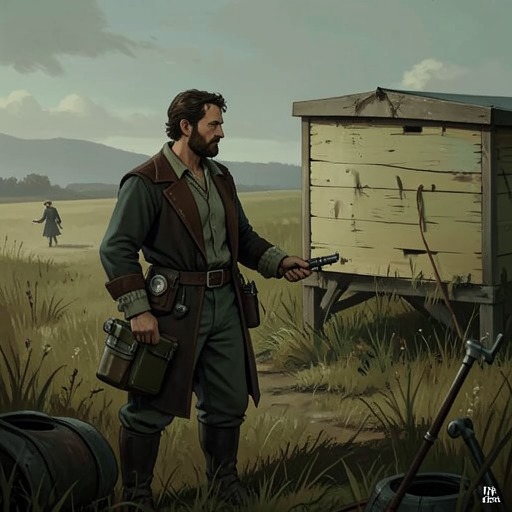
Aisylu advises Sergeyich to travel on a Wednesday, when border queues are shorter. Her plan separates the two travelers for the crossing: he will drive Aisha to the exit, she will pass through the Russian and Ukrainian controls on foot, and he will collect her on the Ukrainian side. Sergeyich agrees, but adds a practical need of his own: he will require help loading his beehives onto the trailer. The escort is therefore not a journey undertaken apart from his other obligations; the bees and their transport remain part of the same difficult passage.
The route’s risks have already been made tangible by Sergeyich’s earlier checkpoint encounters. At one post, soldiers inspect his passport, question his account of coming from Little Starhorodivka in the grey zone, and take both his passport and mobile away for a time. Later, at the crossing into Russia, the long queue of pedestrians and their carts, suitcases, and bags fills both sides of the road. These details establish the border as a lived obstacle, not a line crossed by a simple decision. For Aisha, the plan means walking through the controls alone; for Sergeyich, it means driving the trailer and his bees through the same corridor while searching for her on the other side.
On the morning of their departure, Aisylu and Server follow behind Sergeyich and Aisha as far as Bakhchysarai. At the exit from the Tatar capital, they signal for the Lada to pull over. Aisylu hugs her daughter for the last time and whispers hurriedly in Tatar. Sergeyich watches the two of them: the mother in a modest, long black dress, the daughter in jeans and a dark-green sweater over a black turtleneck. Aisylu nods to him as if telling him to go on, then looks toward the trailer and shakes her head. The hive with the axe mark has a loose bottom plank, which Sergeyich and Server had pressed back into place while loading the bees the night before; Aisylu’s glance registers how precarious the vehicle’s cargo remains even as she entrusts her daughter to its driver.
At the border
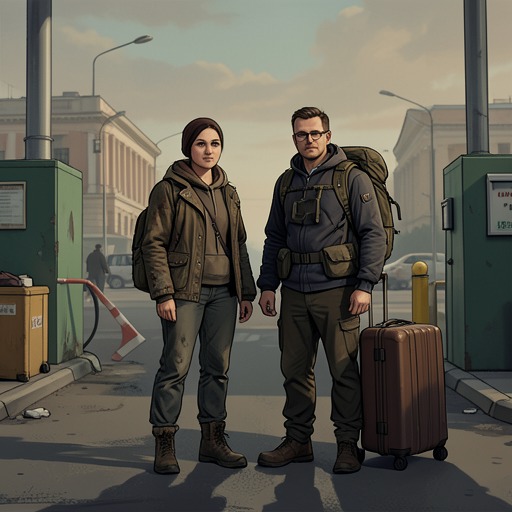
When the Russian soldiers appear, Aisha tenses and fear flashes in her eyes. Sergeyich accelerates to pass them quickly, then slows after remembering that a hive could break apart if the journey shook it too much. The border canopy comes into view, and he stops at the roadside to look to Aisha. She understands without further explanation, gets out, takes her backpack from the back seat, and pulls its straps over her shoulders. She asks whether to take her suitcase; soon she is walking toward passport control with the green suitcase rolling behind her.
Sergeyich enters the queue separately, carrying his own documents to the checkpoint window. He drives slowly through the buffer zone and peers among the people walking in the same direction, looking for Aisha. The separation has turned the crossing into a period of uncertainty: he cannot tell whether she is still among the pedestrians or has already reached the Ukrainian border. On the far side, he parks with part of the trailer projecting nearly a metre over the tarmac, then hurries back toward the drivers and people waiting to meet travelers.
He finds Aisha trying to get out of the crowd, with two men in her way offering competing rides. One promises a place in a car supposedly leaving for the railway station; the other disputes his claim and advertises his own passengers. Sergeyich turns from these improvised offers to a more dependable connection and asks about seats on a train to Vinnytsia. A seat has unexpectedly become available: number eighty-six, an upper berth in the corridor carriage of carriage five, departing in forty minutes. Delighted, he takes it for Aisha. The crossing has brought her within reach of Ukraine, but reaching her destination still depends on the next link in the journey.
A handoff, not an ending
At the fifth carriage, Sergeyich tells Aisha not to leave the platform when she reaches Vinnytsia: Vitalina will meet her there. He gives her Vitalina’s name and telephone number, then reassures her about traveling by train and reminds her to order tea from the conductor, who can provide hot water. These small instructions carry the care of someone trying to make an unfamiliar journey manageable. Sergeyich is not simply transferring Aisha from one place to another; he is arranging for a known person to receive her at the destination.
The conductor calls all aboard in Ukrainian, and fear returns to Aisha’s face. She looks at Sergeyich with pain, as if they were family members being forcibly separated. Before he understands what he is doing, he embraces her and holds her close. The conductor’s impatient warning that the train will not wait breaks the moment into action. Aisha’s departure is thus both a successful handoff and a fresh separation: she is no longer alone in the crowd, but the man who has brought her this far must let her continue without him.
The episode closes on that transition rather than on a settled outcome. Aisha has a ticket to Vinnytsia, Vitalina’s number, and the promise that Vitalina will meet her; Sergeyich has fulfilled his offer to help her reach Ukraine and placed the next stage of her journey in his wife’s hands. The border’s formal divisions remain in force, but the escort crosses them through a chain of practical acts—advice, transport, a bought seat, a contact number, reassurance, and finally an embrace. Its intimate force comes from this modest structure of care, built to carry Aisha forward when her family can no longer make the journey together.